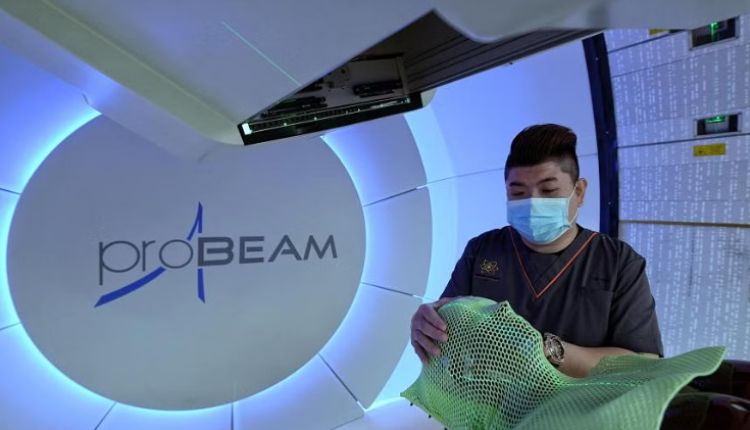
Proton beam therapy, a cutting-edge cancer treatment that minimises side effects, will soon be available in Singapore. The first proton therapy centre in Asia, located in NCCS’ new 24-storey building, is expected to open in 2021. This centre will house a PBT system from Hitachi with four full-rotating gantries and a fixed beam room. This technology can be used to treat a range of tumours in the brain, skull base, spine and head and neck.
Precise Targeting Of Tumours
In comparison to conventional X-ray radiation therapy, which scatters as it travels through the body, proton beams are more precise. They hit the tumour first and deposit their full energy right where the cancer cells are, explains Dr Lee Kuo Ann from Parkway Cancer Centre. This reduces the risk of healthy tissues and organs being damaged by exit radiation. This precision also helps minimise the side effects that are often experienced with traditional radiotherapy. Children, for example, who suffer from tumours of the head and neck, can experience serious side effects such as stunted growth, infertility or impaired cognitive abilities when exposed to X-ray radiation therapy.
Proton therapy in Singapore can be used to treat these tumours, preventing the damage to healthy tissues and organs. In addition, the technology can also be used to treat tumours that are close to vital organs such as the lungs and heart. The first proton beam therapy centre in Singapore, located at the Goh Cheng Liang Proton Therapy Centre at National Cancer Centre Singapore, is expected to start operations by the first quarter of 2023.
Less Damage To Healthy Tissues And Organs
Proton beam therapy can cause less damage to healthy tissue and organs around the tumour than conventional radiotherapy. This can result in fewer treatment-related side effects, especially for children with cancer and patients with tumours in sensitive areas such as the brain, heart, lungs and spine. During proton therapy, you will be positioned using X-ray and CT scans so that the positively charged subatomic particles are targeted exactly where your tumour is located. Your radiation oncologist will then use powerful computing systems to plan and simulate your proton treatment session.
The protons are accelerated in a cyclotron or synchrotron and directed at the tumour site using magnets. NCCS has selected the world-leading Hitachi Proton Beam Therapy system to be installed at Mount Elizabeth Novena Hospital’s new S$78 million state-of-the-art cancer centre that is set to open in 2021. It is the first such facility among private hospitals in Southeast Asia to offer this form of precision cancer treatment.
Minimising Side Effects
As proton beams don’t scatter as much as X-rays, they can spare surrounding healthy tissues and organs more effectively. This is especially important for tumours located close to sensitive organs such as the brain and heart, or when treating children with cancer. With the help of planning scans, like magnetic resonance imaging (MRI) and computerised tomography (CT), your radiation oncologist can carefully plan out where the protons should be directed within your body. The radiation oncologist will also work closely with surgeons and different specialists to decide the best approach for your case.
To ensure that you remain in the same position throughout your proton treatment, your radiation oncologist will use a scanning device called a pencil beam scanner. This enables the proton beam to accurately target your tumour. In addition, advanced computing systems help to model the beam and patient with all the necessary information. This reduces the risk of complications such as damage to lungs or stomach lining from the high doses delivered to the tumour.
Recurrent Tumours Can Be Treated
Patients with recurrent head and neck cancer can also benefit from proton beam therapy. Unlike conventional X-ray radiation, which deposit their energy along their path before hitting the tumour, proton beams stop at the target. This can help to minimise damage to healthy tissue surrounding the tumour, reducing side effects.
Radiation oncologists will work with medical oncologists like Dr Wong, surgeons and different specialists to determine if proton therapy is suitable for each patient. This will depend on the size and location of the tumour, as well as anatomical constraints or underlying comorbidities.
Final Thought
The precision of proton beam therapy also makes it possible to treat cancers near vital organs, such as the eyes, brain, heart and spinal cord. This is especially important in children with cancer who are at a higher risk of experiencing side effects such as stunted growth from conventional radiation treatment. The reduced risks from proton therapy can also improve their quality of life in the long run.